Showing posts with label Bible. Show all posts

Tuesday, July 26, 2011

The Bible Impossible


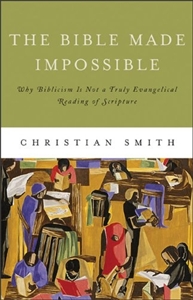
Scot McKnight in his post The Problem with Biblicism part one and two made some insightful comments on Christian Smith's new book.

His [Christian Smith's] argument will look a bit like this: the problem is called biblicism (defined below).
1. He sees biblicism in evangelicalism (not all of it) and in most charismatic and Pentecostal Christianity.
2. Biblicism involves belief in the Bible’s exclusive authority, infallibility, perspicuity, self-sufficiency, internal consistency, self-evident meaning, and universal applicability.
3. Liberalism is the corrosion of historic orthodoxy and is intellectually naive and susceptible to some reprehensible social and political expressions, but opposing liberalism — which Smith does — does not lead to or require biblicism. There are other alternatives.
4. What ultimately defeats biblicism is “pervasive interpretive pluralism.” The Bible says and teaches different things — if you listen to biblicists carefully — about most significant topics. It is, he argues, meaningless to talk about the inerrancy of the text if the interpretation of that text is up for grabs.
5. His goal is to become more evangelical, not less, in approach to Scripture.
6. Christian Smith, a notable Christian sociologist, has become a Roman Catholic, but he wrote this book before that move took place. He had these problems with evangelicalism before he became Catholic, but these problems are part of the reason he became Catholic.
read more
The Bible is central to most evangelical thinking and this has led to biblicism.

What is biblicism? It is a belief that finds expression in this set of ten factors, some holding each factor while others hold most of them. It is characteristic — listen to this — he says of perhaps 100 million Christians! Here are the ten factors of biblicism:
1. Divine Writing: the Bible is identical to God’s own words.
2. Total representation: it is what God wants us to know, all God wants us to know (he quotes JI Packer here) in communicating the divine will to us.
3. Complete coverage: everything relevant to the Christian life is in the Bible.
4. Democratic perspicuity: reasonable humans can read the Bible in his or her language and correctly understand the plain meaning of the text.
5. Commonsense hermeneutic: again, plain meaning; just read it.
6. Solo [not sola] Scripture: we can read the Bible without the aid of creeds or confessions or historical church traditions.
7. Internal harmony: all passages on a given theme mesh together.
8. Universal applicability: the Bible is universally valid for all Christians, wherever and whenever.
9. Inductive method: sit down, read it, and put it together.
10. Handbook model: the Bible is handbook or textbook for the Christian life.
read more.
If we are to approach Christianity with integrity, we will have to admit that the Bible does not have support for many of the claims of Christianity and that many of the major doctrines arises from the interaction of Scripture and the Church (especially Creeds). Reading Karl Barth has helped me to appreciate the relation between the Word of God and God's revelation. So are we really guilty of biblicism? Has the Bible became our God?

What do you think?
.

Thursday, June 23, 2011

Five Ways to Pray the Psalms


May I suggest five ways we can pray the Psalms.

1. Say them out loud

One effective way to pray the Psalms is to read them out loud. Many of the Psalms are meant to be read in public assembly. Reading out loud not only helps you to proclaim the psalms, it also enables you to hear it. Speaking and listen are important aspect of prayers.

2. Use them as a jumping off platform

As you read the psalms, read it slowly and use the words, phrases, sentences as a platform to launch into your own prayers. After you have finished, then go back to where you left of and continue reading. Again launch off as you felt let to pray around the words or theme in the psalms. For example in Psalm 23:3, when you read “he restores my soul…” you might want to pray about your spiritual life, your present struggles and appeal for his intervention.

3. Paraphase them

Rewrite the psalms in your own words. When you paraphrase the psalm, you are interacting with you seek to understand the main points and to express it your way. It also helps to paraphrase in your own language if English is not your first language.

4. Memorise them

Memorising parts or whole psalms are another way to pray them. Repeat the psalms you have memorized continually and he begin to understand what St.Paul means when he asks us to praying unceasingly. Using memorized portion or whole of the psalms in your prayer is useful when you do not know what to say when you pray. Sometimes you will find that the psalmist can express your needs better than you can say it.


5. Let them talk to you

Use the spiritual discipline of lectio divina to read the psalms during your prayer and let the psalms speak to you. Lectio divina or spiritual reading involves reading, meditating, praying and contemplating. These four movements help us to listen to the psalms and allow the Holy Spirit to speak to us.

These are some of the ways you can pray the psalms.


.

Wednesday, May 25, 2011

Evangelical Exegetical Commentary

Logos Bible Software -- NewsWire!

Evangelical Exegetical Commentary (44 vols.)    

Evangelical Exegetical Commentary (44 vols.)


Retail Price: $2,195.95
Pre-Pub Price: $749.95
 
Learn More   Buy Now!  
 
 
A few years ago, a core group of Bible scholars began to dream of what a new Bible commentary could look like . . .
What if a new commentary series could be published—a kind of commentary pastors could use for sermon preparation, and a standard reference work seminary students could consult for exegetical research? What if this commentary was designed and written primarily for a digital environment—and especially for use in Logos Bible Software?
The Evangelical Exegetical Commentary began out of those conversations.
Now, that dream is about to become a reality. In just a few days, the first volume in this brand new commentary series will be released.

Individual Titles

  • Genesis, William Barrick
  • Exodus, Eugene Carpenter
  • Leviticus, Richard Averbeck
  • Numbers, R. Dennis Cole
  • Deuteronomy, Eugene Merrill
  • Joshua, Ralph Hawkins
  • Judges, Fred Mabie
  • Ruth, Ronald Youngblood
  • 1 & 2 Samuel, Harry Hoffner
  • 1 & 2 Kings, John Oswalt
  • 1 & 2 Chronicles, Eugene Mayhew
  • Ezra & Nehemiah, Israel Loken
  • Esther, Anthony Tomasino
  • Job, Duane Garrett
  • Psalms, Ronald B. Allen
  • Proverbs, author TBA
  • Ecclesiastes & Song of Solomon, author TBA
  • Isaiah, Todd S. Beall
  • Jeremiah & Lamentations, Walter C. Kaiser, Jr.
  • Ezekiel, Mark Rooker
  • Daniel, Randall Price
  • Hosea, Joel, & Obadiah, Gary Yates
  • Amos, Jonah, & Micah, Michael Grisanti
  • Nahum, Habakkuk, Zephaniah, Haggai, Zechariah, Malachi, Dorian Coover-Cox
  • Matthew, David Lowery
  • Mark, author TBA
  • Luke, Stanley E. Porter
  • John, W. Hall Harris
  • Acts, Douglas Huffman
  • Romans, Edwin Blum
  • 1 Corinthians, H. Wayne House
  • 2 Corinthians, Andrew W. Pitts
  • Galatians, Michael Burer
  • Ephesians, Steve Baugh
  • Philippians, Mark Keown
  • Colossians & Philemon, H. Wayne House and Seth Ehorn
  • 1 & 2 Thessalonians, Robert Thomas
  • 1 & 2 Timothy, Titus, Steve Stanley
  • Hebrews, Buist Fanning
  • James, William Varner
  • 1 & 2 Peter, Jude, Edward Glenny and Herbert Bateman
  • 1, 2, & 3 John, Gary Derickson
  • Revelation, Michael Stallard

Benefits of the Logos Bible Software Edition

The publication of the Evangelical Exegetical Commentary by Logos marks the first time a major Bible commentary series has been published in digital form before its print counterpart—and the first time it has been published with a digital format in mind.

.

Sunday, March 20, 2011

Why Defacement of the Alkitab is Desecration

nkw expands on his earlier post 


Why Defacement of the Alkitab is Desecration
By nkw

Some government officials have claimed that Christians are making an unnecessary fuss over the recent stamping of the Alkitab seized in Port Klang and Kuching. After all, they say, the Government also requires copies of the Quran to be chopped/stamped with a notice of government approval before they are sold in the shops.

Even some Christians also wonder why such a big deal is being made about the stamping since Christians, unlike Muslims, do not regard printed copies of the Bible with reverence. It is just a printed text. What matters is the message conveyed by the Bible.

This article seeks to address the failure to understand the reason for rejecting the stamping of the Alkitab.


read more

.

Thursday, March 17, 2011

Malay Bibles Desecrated by Malaysian Authorities

Here is a posting from nkm which I have reproduced in full. For more read here


Malay Bibles Desecrated by Malaysian Authorities

By nkw
 
“Oh No! They killed our loved ones even though we paid the ransom.”
This is the worst nightmare experienced by people who paid ransom to kidnappers  only to find their loved ones returned to them executed.

“Oh No! They desecrated our beloved Holy Bibles.”

This is the heart wrenching experience of Malaysian Christians who found their Holy Bibles returned to them defaced and desecrated. Malaysian Christians have earlier out of courtesy and grace agreed with the government to print the Alkitab (Malay Bible) with the symbol of the cross on the front cover along with the caption “A Christian Publication” [ The claim by the Minister of Home Affairs that Christians have earlier agreed to have the phrase, "For Christians only" stamped on the Alkitab is a lie. There was no such agreement. His statement, "We stamped the Bible based on amalan (practice) before… during Abdullah Badawi and even Tun Dr Mahathir’s time,” is also a lie].

Nevertheless, the authorities proceeded to detain 5000 copies of the Alkitab for the last two years.
Malaysian Christians  waited with guarded optimism when the government recently announced that it will release the Alkitab that have been confiscated but to their horror they were suddenly informed that the authorities have hurriedly and unilaterally stamped all the Alkitab with an ugly notification from the Ministry of Home Affairs. See picture below.


The English translation reads: Reminder: This ‘Al Kitab Berita Baik’ is for the use of Christians only. By order of the Home Minister.”

Notice the official chop/stamp (Bottom Left) and the serial number that is to be imprinted onto the Bible (Upper Right).

The defaced Bible is now imprinted with a serial number, obviously to facilitate the authorities threatening to track every copy of the Alkitab used by the community.

Christians are horrified by the arrogance of the officials. The contemptuous act of defacing the Alkitab is nothing less than sacrilege.

The Christian Federation of Malaysia rightly expressed that they felt “deeply hurt”. I think it is being polite. “Outrage” would have been a more appropriate word.

I think the only proper thing for the government to do is to make immediate amends: Apologize for its callous act. Return the Alkitab back to the publisher and replace them with new Alkitab. Under no circumstances should these defaced Alkitab be destroyed – that would be another act of desecration. The government should bear all costs and give written assurance that such desecration will never happen again.

O God, your Holy Scripture has been desecrated, your name and reputation defiled! When will you rise up and judge all these arrogant offenders for their blatant act of sacrilege?

read more

.

Tuesday, March 15, 2011

Barth's The Problem of Dogmatics


Now that I have Karl Barth's Church Dogmatics, I can join Professor Daniel Kirk's The Barth Synchroblogs Karl Barth Reading. The first thing I discovered is that the Church Dogmatics is not easy reading! The fonts are small and smaller (there are two font sizes in the text) and the sentences are not reader friendly (maybe they are for theologians). The plan is to read though the fourteen volumes in 11 years.

This week's reading is on §7.1 The Problem of Dogmatics is an eye opener for me.

Barth states that God's Word is "provisionally comprehensible and comprehensible in all its incomprehensibility" (249). This is as cryptic and profound as Karl Rahler's "the economic Trinity is the immanent Trinity, and the immanent Trinity is the economic Trinity". What Barth means is that the Word of God is "provisionally" comprehensible because in our reading we can get insights from it. However it is "incomprehensible" because there are limits to our understanding of the Word. This is because when we receive the Word, we do not receive it directly but through "recollection" and "reflection". This really throws a spanner into the evangelical worldview where it is assumed that we receive it directly.

I like the way Barth argues his theses. He argues like a scientist rather than a philosopher (or a theologian). He get straight to the gist of the thesis, presents his facts and findings and draws a conclusion. He examines the relation of the Word of God and the Church. One can get lost in his words: Bible, Church, tradition, dogma or dogmas, and dogmatics. However, instead of being caught up in terms and their usage, Barth declares that " [d]ogma is the relation between the God who commands and the man who obeys His command, the relation which takes place in the event of this commanding and obeying" (274).

and that is so cool.


Monday, February 21, 2011

Scripture is Electric

All scripture is inspired, but some of it is electric. The power of the Holy Spirit hums in the lines so thrillingly that you hardly dare to touch them. For me, the first chapters of Ephesians and Colossians spring to mind, especially the verses where Paul shows us Jesus Christ in his supremacy. God gave his one and only Son as "the atoning sacrifice for our sins" (1 John 4:10). But Paul sets that mighty work inside a mightier one. With trumpets sounding in his soul, he exclaims that through Jesus' sacrifice, God was pleased "to reconcile to himself all things" (Col. 1:20) as part of a still mightier plan for the ages when God will at last "gather up all things in him, things in heaven and things on earth" (Eph. 1:10).


Cornelius Plantinga Jr. is president of Calvin Theological Seminary.

Friday, February 4, 2011

Frederica Mathewes-Green on the Authority of Scripture

Here is a wonderful blogcast and comment from  Frederica Mathewes-Green on the authority of Scripture from the Orthodox perspective.

This week's podcast is about the authority of Scripture, and the assertion that it is "infallible."

Infallible R Us

It came about as a response to an email I received from a Protestant clergyman asking about the Orthodox view of the authority of Scripture. He said that in his own church there are debates about morality and theology, and those who want to adhere to a classic or traditional stand tend to do so on the basis of Scripture, and for that reason must defend the Scriptures as unimpeachable. He wanted to know how the Orthodox handle this question.

I think the main difference is that we see the Scripture as having the highest authority in our community--but it is read within a community, the community that originally wrote and originally heard these words. Everybody interprets the scriptures. It is not possible to read them and give the same weight to every passage. It is not even likely that anyone will read it all as uniformly literal--many Protestants think Jesus' words about his Body and Blood, in John 6, were meant metaphorically, while we liturgical Christians take them as literal.

The debates about what the scriptures mean are really a debate about whose interpretation you are going to follow--Luther, Calvin, St. Thomas Aquinas, etc. For us Orthodox, the Scriptures mean what the community says they mean, those who wrote and received the New Testament scriptures when they were new. So the bible is not seen as something independent of human readers and believers, like an object floating in space. It is always read in a context of human interpreters, and we think the original writers and readers are best equipped to have the accurate interpretation.

It's a different angle from one that would want to determine whether the words standing alone are "infallible." An interesting question. I got an email from an Orthodox priest this morning saying that I went too far, and that the Church Fathers (he quoted St. Augustine) see the words of the bible as literally true, and if there appears to be a problem, it is in the reader's understanding. Worth thinking about further--but this part, about being guided by the interpretation of the community, still holds.

Sunday, January 23, 2011

King James Bible: Old Words New Meaning

I am sure we are all aware of how some English words change their meaning over time. One such example that instantly come to mind is "gay." When I was learning English as a child, I was taught that it means happy or merry. Now obviously it does not have that meaning. Chris Armstrong (Dr.Christian History) over in his blog Grateful to the dead have some interesting experiences with the King James Bible. I especially like the original meaning of flagons.

The following are just a few of the more than 500 words that could trip up modern readers of the King James Version, because they now mean something different—often very different!—than they did in the early 1600s when the KJV was being translated.

accursed devoted, Josh 6:17, 18; 7:1, 11–13, 15; 22:20; 1 Chr 2:7. This one shocked me!

addicted devoted, 1 Cor 16:15. And this one, though more understandable, could also cause considerable confusion in the modern reader.


allow (1) approve, Luke 11:48; Rom 14:22; 1 Thess 2:4. (2) accept, Acts 24:15. (3) know, Rom 7:15. Just as with modern English, KJV terms can have two, three, or even more meanings. And all of them can be remote from our modern understandings.

amazement terror, 1 Pet 3:6. A much stronger and more negative meaning. We’ve sort of domesticated this word, haven’t we?

bowels (1) heart(s) (metaphorically, as the seat of emotion), Gen 43:30; 1 Kgs 3:26; Ps 109:18; Isa 16:11; 63:15; Jer 31:20; Lam 1:20; 2:11; Phlm 7, 12, 20. (2) compassion, Isa 63:15; Phil 1:8; 2:1; Col 3:12. (3) affections, 2 Cor 6:12. (4) anguish, Jer 4:19. (5) innermost self, Song 5:4. A difficult image for us to appreciate today; seems to derive from an ancient Hebrew understanding of the “guts” as the seat of compassionate emotion. The closest we have now is in phrases like “go with your gut” and “gut check,” which refers more to intuition than love.

bruit report, Jer 10:22; Nah 3:19. This is a fun archaism still used in the jocular “schoolboy English” of 20th-century British literature, often in the phrase “bruited about,” referring to a widely disseminated piece of gossip or other information; as in, “it was bruited about that the bishop kept a secret mistress.”

by and by immediately, Matt 13:21; Mark 6:25; Luke 17:7; 21:9. Today, “by and by” seems to have the opposite meaning—something that will happen eventually.

careful anxious, Luke 10:41; Phil 4:6. So, in the Sermon on the Mount, “Be careful for nothing” means, “don’t let anything make you full of care,” that is, “make you anxious.”

charity love, 1 Cor 8:1; 13:1–4, 8, 13; 14:1; 16:14; Col 3:14; 1 Thess 3:6; 2 Thess 1:3; 1 Tim 1:5; 2:15; 4:12; 2 Tim 2:22; 3:10; Titus 2:2; 1 Pet 4:8; 5:14; 2 Pet 1:7; 3 John 6; Jude 12; Rev 2:19.In other words, “charity” in the King James Version does not have the limited meaning it holds today, of giving something to someone less fortunate than yourself.

closet(s) private room(s), Joel 2:16; Matt 6:6; Luke 12:3. Hence the odd English term still used today, “prayer closet,” which has nothing to do with a clothes-closet.

conversation (1) way of life, 2 Cor 1:12; Gal 1:13; Eph 2:3; 4:22; Phil 1:27; 1 Tim 4:12; Heb 13:5, 7; Jas 3:13; 1 Pet 1:8; 2:12; 3:1, 2, 16; 2 Pet 2:7; 3:11. (2) life, 1 Pet 1:15. (3) in the way, Ps 37:14; 50:23. (4) citizenship, Phil 3:20. This is another 17th-century word whose modern meaning has taken, in the immortal words of Bugs Bunny, a significant “left turn at Albuquerque.”
discover(ed) (eth) (ing) (1) uncover(ed) (ing), Lev 20:18; Deut 22:30; 2 Sam 22:16; Ps 18:15; Isa 3:17; 57:8; Jer 13:26; Ezek 13:14; 16:57; 23:10, 18, 29; Hos 2:10; Nah 3:5; Hab 3:13. (2) reveal, Prov 18:2. (3) disclose(d), 1 Sam 14:8, 11. (4) strip, Ps 29:9. (5) removed, Isa 22:8. Five meanings, and not one of them “found,” the common modern meaning.

dragons (1) jackals, Job 30:29; Ps 44:19; Isa 13:22; 34:13; 35:7; 43:20; Jer 9:11; 10:22; 14:6; 49:33; 51:37; Mic 1:8; Mal 1:3. (2) sea monsters, Ps 148:7. I’d like to know how this first meaning relates to our meaning of “dragons” today: the wild dog doesn’t bear much resemblance to the mythical creature!

flagons cakes of raisins, Song 2:5. flagon(s) of wine cake(s) of raisins, 2 Sam 6:19; 1 Chr 16:3; Hos 3:1. Wow! Almost as bad a mix-up here as the one revealed in 2001 by Quranic scholar Christoph Luxemberg, who concluded that the “seventy virgins” promised in paradise to Muslim men martyred for their cause were actually, owing to an unfortunate misunderstanding, raisins. Imagine the disappointment.

read more

Tuesday, December 14, 2010

The Scriptural Bible and the Academic Bible

Interesting insight from Scot McKnight on the Scripture Bible and Academic Bible.

Let this be said: what approach we use in reading the Bible determines not only what we see in the Bible or get from the Bible but also who we become. In other words, if we bracket faith and bracket theology and bracket orthodoxy, we will eventually learn to read the Bible without faith and theology and orthodoxy, and that leads — often enough — to the lack of faith, the lack of theology, and the lack of theology. What is permitted it is what comes out.

read more

Tuesday, November 2, 2010

NIV10

Another update for the NIV Bible.

Welcome to Bible Gateway!

We are proud to announce the unveiling of the New International Version of the Bible, updated for 2011. The updated translation replaces two earlier texts (the NIV 1984 and the TNIV). You can read all 3 versions here and compare them to one another.

What do you think? Need another updated version?

.

    Monday, October 18, 2010

    The City of the Word


    “There he is,” shouted disciple Ah Lian, as Abba Ah Beng walked wearily through the Sow-lin Monastery gate. “Abba, how was your journey?” Abba Ah Beng smiled lovingly as his excited disciples clustered around him, shouting and dancing with joy at his return. “You have been away for six whole months!” exclaimed disciple Ah Kow who was jumping energetically. “Yes, tell us what you saw,” inquired exchange disciple Iskandar. “What did you bring me?” asked disciple Ah Lek eagerly.

    Abba Ah Beng lowered himself onto his favourite stool underneath the Frangipani tree. The tree was in bloom and the fragrance of the flowers embraced them like a warm comforter on a cold winter’s night. The Abba looked frail and exhausted. His winkles seem to have deepened with age in the past six months he had been away and his eyes have a haunted look which his disciples had not seen before.

    “Thank you,” Abba Ah Beng said as he accepted a cup of cool water from the spring in the back gardens. “It is good to see you again, my beloved disciples.” Abba Ah Beng has a distinctive way of speaking that comes from reading too much of the King James Bible in its first edition.

    “As you know I have been on a long quest to seek the famous City of the Word. I have tracked the foothills of the Himalayas and braved the jungles of Sarawak to track down this elusive city. After many adventures, hardships and dangers, I finally found the fabled city. It lay in the East from which much wisdom has been arisen.

    “It was a bright cool morning when I finally entered the city gates. There was a cool breeze and the sky was bright blue. In the background, I can hear the beautiful singing of the thorn birds. The people of the city came out to greet me. They are extremely friendly and gracious. I was welcomed with food and drinks and a place of rest. The people are happy and they have a peaceful look on their faces. However I noticed that all the adults have only their left eyes and their left hands. I also noticed that they all discretely gazed at my right eye and right hand.

    “ ‘Is this the City of the Word where the people are blessed by their obedience to the Scriptures?’ I asked them. ‘Oh, yes,’ they replied happily, ‘we are that city and in our obedience to Scripture, we are not longer cursed by evil. We are happy and God has blessed us abundantly.’ ‘Then what happened to your right eyes and right hands?’ I asked the Chief Priest who was among the first to welcome me. ‘Don’t you know, Abba?’ answered the man in surprised.

    The Chief Priest then led me to their temple which was built in the exact centre of the city over a river which flowed through the city. The people were following us and soon it became a big procession. There was a hush as we entered the temple. Ahead at the front of the temple on the altar was an opened Scripture. The Chief Priest led me to the open book and asked me to read. I read, ‘And if thy right eye offend thee, pluck it out, and cast it from thee: for it is profitable for thee that one of thy members should perish, and not that thy whole body should be cast into hell. And if thy right hand offend thee, cut it off, and cast it from thee: for it is profitable for thee that one of thy members should perish, and not that thy whole body should be cast into hell.’

    Then I understood. ‘You plucked out your right eyes and cut off your right hands yourself!’ ‘Yes,’ answered the Chief Priest proudly, ‘All of us are now safe from evil except for the children who are too young to know better. What about you, Abba? Will you like to save your soul from hell by the way the Scripture taught?’

    “I told them that I would like to pray and meditate before my commitment to that course of action as the sky was darkening towards evening. After a simple meal, they directed me to a simple cell which is to be my lodging for the night. I waited for them to fall asleep, then crept out of the cell through the window, climbed over the city wall and ran as fast and as far as I can from this City of the Word. I am so happy to finally see the walls of the monastery and your faces,” concluded Abba Ah Beng. There was silence after that as the young disciples tried to understand the horror of what they have heard.

    “I thought that the City of the Word is a holy city and the people who lived there are blessed,” mused disciple Ah Kow.

    “Yes,” said Abba Ah Beng wearily, “the City of the Word is a holy and blessed city. But you see, I went to the wrong city!”

    “I went to the City of the Literal Word.”


    picture source

    Friday, July 23, 2010

    Study on Jeremiah

    I intend to spend the next six months immersed in the study of the Book of Jeremiah and Lamentations. For me this is the best way to study a topic or subject. I have started with these books


    including these digital books in my Logos library software
    Word Biblical Commentary Vol. 26, Jeremiah 1-25(craigie/kelley/drinkard)
    Word Biblical Commentary Vol. 27, Jeremiah 26-52 (keown/scalise/smothers)

    Are there any other books on Jeremiah or Lamentations that you think will be good for me to study? Will appreciate your recommendations.

    .

    Thursday, July 22, 2010

    Rethinking the Wesleyan Quadrilateral

    Guest T wrote an interesting post about the Wesleyan Quadrilateral and asked some important questions on Scot McKnight's The Jesus Creed blog.


    How exactly do we come to think what we do about God? How do we think about each of Scripture, Tradition, Reason, and Experience separately in relation to good theology? How do we think they inter-relate in our actual practice and how should they inter-relate?

    Hopefully a post on each of the four "quads" will be helpful for all of us to think about those questions and refine our own approach. Before we look at each of the four individually, though, a little background is in order. First, Wesley saw scripture as clearly primary among the four. In fact, he saw the other three as the unavoidable lens through which we viewed everything, including scripture and even God himself. We should note that the Quadrilateral is offered as both prescriptive (for how we ought to build our theology) and descriptive (of how we all inevitably assemble our knowledge of God). Of course, the emphasis we put on each "quad" may make for a wide margin between the prescriptive and the descriptive uses, as well as the ideas about God that we end up with. (And two quick points for the record: 1. I'm not Methodist, so folks from that background may want to give correction or depth to my summaries, and 2. although the quadrilateral is faithful to Wesley's theology, the term "quadrilateral" was coined by a much later admirer of Wesley's approach.)

    I agree with Wesley that scripture should be primary among the four; I also agree that it should not be, perhaps more importantly, cannot be the only player in forming our knowledge of God. Scripture often supports contrasting claims about God. It presents opposite truths in tension. It leaves a sea of questions unanswered. Some explicit statements we don't take explicitly. And we place enormous weight on some Reasonable inferences (like the Trinity, for instance), especially those that have the support of Tradition. Not only do Tradition, Experience and Reason form the lens for our view of Scripture, they address, with Scripture, they explore and fill in many gaps in our understanding of God, some of which Scripture itself creates. Perhaps most importantly, they make the faith into our faith.

    Please note that the highlight in bold is mine and not in the post.

    Read more

    .