Showing posts with label Malaysia. Show all posts

Wednesday, November 16, 2011

Pagalvan's Future Doctors: Malaysian Healthcare System for Dummies

Prolific blogger Dr Pagalvan has posted some insights on the Malaysian Healthcare system. These are in his series For Future Doctors: Malaysian Healthcare System for Dummies part 1 | part 2 | part 3 | part 4. All students who wants to study medicine and especially all parents who want their children to take up medicine should read this.

.

The Standards of Medical Education in Malaysia

The Standards of Medical Education in Malaysia and Its Acceptability
Dr. David KL Quek,
MBBS, MRCP, FRCP, FAMM, FCCP, FASCC, FAPSC, FNHAM, FACC, FAFPM (Hon.)
Immediate Past President, Malaysian Medical Association (MMA)
(Lecture presented at the Medico-Legal Society of Malaysia Conference, Royale Chulan Hotel, Kuala Lumpur, on 16 November 2011)

An insightful lecture by a previous President of the Malaysia Medical Association posted on his blog MyHealthMatters,


The standards of our medical education are falling. This is an unacceptable trend, which should not be allowed to continue. If we do not take drastic remedial steps and actions to stall this slide, we might see a deteriorating climate of healthcare services in the country, with possible lowering of our medical professionalism and our clinical expertise as a whole. We might be reduced to the standards of some of the third world countries’ health services, where excellence is a rarity than a norm.
We could see a decline in our competitiveness, our competence and a deteriorating belief in ourselves, as a developed nation—perhaps to be bogged down once again in a quicksand trap of mediocrity and ‘tidak apa’ lackadaisical mindset. We might soon be having so many poor quality doctors and medical graduates who may be unemployed, even unemployable, and not trusted to be good enough to be our healthcare providers!
Potentially, there could be greater chances of endangering of patient safety and lives, for medical mishaps and errors, and greater risks for medico-legal challenges. Finally, the quality of our health service could deteriorate so much that our routine services would be called into question, with possibly the skeptical questioning of the integrity and foundations of our health service. Instead of trust in our health service, we could see the reversed medical tourism of more and more of our own citizens to other neighbouring countries with perceived higher standards of care and excellence of service!
read more

Friday, November 4, 2011

Kassim Ahmad's The Road Home


This interesting autobiography (2011) by Kassim Ahmad details his humble origin as a kampung boy from Kedah to his days in the University of Malaya, his four years of lecturing in the School of Oriental and African Studies, University of London in the UK before returning to teach at a secondary school in Penang. It also details his intellectual development from a school boy to liberal socialism, then socialist Marxism, his eventual rejection of it and his return to Islam. His commitment to the socialist cause made him an activist and inevitably into politics. He become chairman of Parti Rakyat Malaya which he led for 18 years. He was detained under ISA for more than 5 years. Ultimately, according to Kassim, it was his disillusion with socialist Marxism that led him to resign from Parti Rakyat Malaya in 1984 and joined UMNO in 1986. In the years following, his renewed interest in Islam led to his controversial analysis of the Hadith which provoke much debate and discussion.

It is not a straight forward narrative autobiography because Kassim interspersed the events in his life with his commentaries on socialism, colonialism, political sciences, philosophy, imperialism, Islam and Malaysian politics. He seems to have a good memory for names because there is a large number of people mentioned in this book. To my delight, he also mentioned the names of books and authors that were influential in his intellectual and political development.

Kassim Ahmad's blog Kassim Ahmad

Sunday, October 30, 2011

Autographed Books


Bought these two books at the National Association of National Counsellors Malaysia and have them autographed by the authors. Edmund Ng is the new Chairman of the association and John Court is the principal speaker. Am proud and privileged to attend the inaugural conference of the newly minted organisation in Malaysia.

.

Tuesday, October 25, 2011

Happy Deepavali to my readers


This beautiful kolam made of coloured rice grains is on display at City Square Shopping Mall in Johor Bahru.

Sunday, August 21, 2011

English as I Speakee It

Overseas readers of this blog and my corresponding website often scratch their heads in puzzlement at my English or rather the way I use it.

Peggy Tan highlights the way Malaysians speakee English

Asking someone to make way
Britons: Excuse me, I’d like to get by. Would you please make way for me?
Malaysians: S-kews / squeeze me, please.
Asking someone to find out what had happened
Britons: Will someone please tell me what has just happened?
Malaysians: What happenleh? Why like that one?
When asking for permission
Britons: Excuse me, but do you think it would be possible for me to enter through this door?
Malaysians: (pointing at the door) Can enter ah?
When assessing a difficult situation
Britons: Hmmm. We appear to be in a bit of a predicament at the moment.
Malaysians: Ayoh! Die-lah! Mati loh?
When declining an offer
Britons: If you don’t mind, I’d prefer not to do that.
Malaysians: I don’t want lah.
In disagreeing on a topic of discussion
Britons: If you don’t mind, Timothy, I do have to interrupt, and I must say I have to disagree with you about this issue.
Malaysians: What stupid idea! You mad and crazy ah?
When asking somebody if he/she knows you
Britons: Excuse me, but you seem to be staring at me. Have we met before?
Malaysians: Why you look at me like that? See what?
When someone is angry
Britons: Would you mind not shouting at me?
Malaysians: Cilakak! You no manners or what man!

read the rest of the article here

.

Sunday, July 24, 2011

Concerns about National Health Insurance Scheme in Malaysia

From his blog MYHealthMatters, former Malaysia Medical Association president Dr David Quek highlights

ICare medical scheme – a crony treatment?

FMT Staff | July 25, 2011
Private practioners nationwide are concerned about the government scheme, which they fear will only benefit a few private companies.


TAWAU: A proposed medical insurance scheme by the government has raised concern among private practioners here and across the peninsular.
Suspicion has risen over the 1Care scheme which many believe will only benefit a few private companies at the expense of patients and doctors.
The doctors fear that healthcare expenses will increase as 1Care will become a monopoly through a giant managed-care organisation (MCO).
Although the government is yet to reveal the full details of the 1Care scheme, initial disclosures have raised concerns.
read more

.

Wednesday, April 6, 2011

Michael Moorthy and Boys' Brigade in Asia

Well done Michael Moorthy. This article is reproduced from the City Harvest website citynews. An oversight in this article is that it fails to mention that the 1st JB Company is sponsored by the Holy Light Church (English) in Johor Bahru, Malaysia, and Michael Moorthy's involvement since 1966 is fully sponsored and supported by the church even after he has chosen to worship with City Harvest Church in 1997.

A “Sure And Steadfast” Man

Posted on 05 April 2011

Business owner Michael Moorthy serves three posts in the Boys’ Brigade in Asia. He shares his passion for his mission.
Contributed By Nicolette Ng

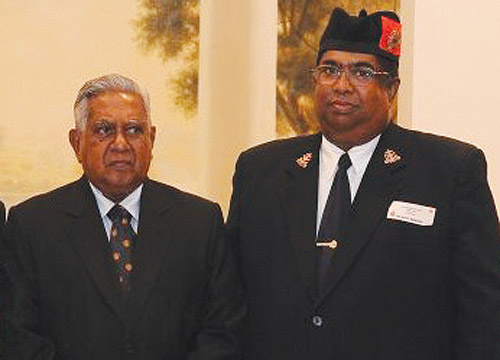
Moorthy (right) with Singapore’s President S.R. Nathan. PHOTO COURTESY OF MICHAEL MOORTHY
Michael Moorthy, 59, is not quite your average business owner.

Moorthy, the director of Anjung Segar Sdn Bhd, a frozen foods company, is “on call” for the Boys’ Brigade, which he serves as the president of Boys’ Brigade Malaysia, the president of Boys Brigade Asia, as well as the honorary captain of the 1st Johor Bahru Boys’ Brigade company.

The oldest uniformed group in the world, the BB is an interdenominational Christian youth organization, conceived by William Alexander Smith in Glasgow in 1883, which combines drill and fun activities with Christian values.

What sets the BB apart is that its activities not only cater to the physical and mental development of the youth, but also their spiritual development through Christian education classes and activities. This is also where the “graduated” pool of officers who are all volunteers comes in to train the next generation after being blessed by the BB. These people are role models and impact the lives of the young people entrusted in their hands. Their motto: “Sure and Steadfast.”

Having many youths in his care, Moorthy shares that as captain of the 1st JB Company, he is responsible for the overall direction and vision of where the Company is headed in terms of growth and planning their calendar for the year, whilst also ensuring that the weekly operations and meetings run smoothly.
Through a holistic program, the BB instils discipline and the development of three key areas: body, soul and spirit. While updating their programs regularly to mold the character and leadership skills of the youths is effective, Moorthy shares that it is important not to lose sight of sharing Christ with them in the process. The BB’s objective is “The advancement of Christ’s kingdom among Boys and the promotion of habits of Obedience, Reverence, Discipline, Self-respect and all that tends towards a true Christian manliness.”

It was in 1966 when Moorthy, impressed by the uniforms, badges and the marching band and caving in to the persistent encouragement of his classmates, joined the BB. There has been no turning back since. It was also through the BB that Moorthy got to know Christ as his Savior. It is no surprise that Moorthy’s greatest satisfaction from the ministry is to know that through the BB, they are changing lives and reaching out to young people who are transformed to become better members of the society.


The Moorthy family. PHOTO COURTESY OF MICHAEL MOORTHY

Moorthy acknowledges that the success the Companies have had come about because of a group effort. “I’m only as effective and efficient as the team of fellow volunteer officers I’ve had around me over the years, and I have been blessed to have their support.”

To date, the 1st JB Boys’ Brigade Company has grown to become one of the largest Companies in Malaysia. One milestone for them was when their marching band played overseas in Thailand and China, and was featured in the Malaysian Book of Records for being the First Youth Marching Band to play at the Great Wall of China.

The City Harvest Church member and his family from JB first encountered the church in 1997. “We just fell in love with CHC, the praise and worship, the inspiring messages by Pastor Kong. The love and care from our friends over the years made us realize that CHC is not just a mega-church but a mega-caring church,” says Moorthy. Since those days of the church at Hollywood Theatre, Moorthy and his wife, Janet, and their four children have commuted across the Causeway every single weekend to attend service. It comes as no surprise that his eldest and second son were also BB members.

His is a life and a family that is dedicated to the cause of Christ. “It is my belief for my family and me, that we are all about tending God’s business, and will do our best to the measure He has entrusted to us.”

A Call to Prayer for the Church & Our Nation Malaysia

To: The Body of Christ in Malaysia

A CALL TO PRAYER FOR THE CHURCH & OUR NATION MALAYSIA

**********
INTRODUCTION

As Christians and God’s people in Malaysia,
• We are called to pray for our beloved country so that Habakkuk’s vision, “For the earth will be filled with the knowledge of the glory of the LORD, as the waters cover the sea” (Habakkuk 2:14), will be fulfilled in our land.
As Christians and God’s people in Malaysia,
• We believe that God’s message to His people through Jeremiah, “Seek the welfare of the city where I have sent you … and pray to the LORD on its behalf, for in its welfare you will find your welfare” (Jeremiah 29:7), is also His word for us today.


I. THE CHURCH—HOLY, REVIVED & VIBRANT
1. Humbling Ourselves to Seek God in Prayer
In Acts 1 we read of how a ten-day prayer meeting preceded the release of the Holy Spirit at Pentecost. Similarly, earnest and persistent prayer led to great revivals which had lasting and world-changing effects. These include the Moravian Revival (1727), the Great Awakening in America (18th century), the Welsh Revival (1904), the Azusa Street Revival (1906) and the Korean Revival (1907).
Closer to home, the several waves of revival experienced by the SIB have often been preceded and sustained by prevailing prayer and holy living. This has resulted in SIB being the fastest growing church in the country in the last few decades, with whole tribal communities being holistically transformed along the way.
a. Pray that the Malaysian church will seek the face of God together earnestly and with perseverance, so that He will open the heavens, reveal His glory and pour His power upon our nation. Let us claim His promise that “if my people … humble themselves, and pray, and seek my face and turn from their wicked ways, then I will hear from heaven and will forgive their sin and heal their land” (2 Chronicles 7:14).


2. Emphasising Holiness and Righteousness in the Church
The Malaysian church can only be a prophetic community, impacting society, when we live authentic and vibrant Christian lives. Only then the church can act and speak with credibility and moral authority, and be taken seriously by the world.
a. Pray that pastors, church leaders and members will strive to live godly lives at home, in church, and in the market place and the public square.
b. Pray that every church will provide systematic teaching on holy living from the pulpit, in our small groups, and at every level of church ministry.


3. Fostering Church Unity and the Ministry Of Reconciliation
We live in a society where ethnic tensions and divisions have deteriorated badly. But for the church, God has already brought peace and unity through the cross (Ephesians 2:14ff).
a. Pray that Christians will make every effort to keep the unity of the Spirit, embracing reconciliation within the Christian community.
b. Pray that as Christian leaders, local churches and whole denominations learn to live in unity, through forgiveness and reconciliation, we will model ethnic reconciliation powerfully in our nation.


4. Teaching Christians the Cost of Discipleship
We must be intentional in teaching that Jesus taught clearly that there is always a cost in following him as true disciples (Luke 9:23). One consequence of our failure here has been the mass exodus of Christians leaving the country through emigration, which has weakened both the church in Malaysia and our contribution to nation-building.
a. Pray that Christians will understand what true discipleship means, and be willing to take up their cross daily and suffer for Christ.
b. Pray that many Christian professionals and countless university students studying abroad will return with a clear vision to build both the church and nation.
c. Pray that Christian parents will encourage their children to come home or to remain in Malaysia to serve God here.


5. Developing Godly Leadership for Our Churches
There is a great need in our time for godly leaders who model Christ-like servanthood. Further, as Paul advised Timothy, “what you have heard from me … entrust to faithful men who will be able to teach others as well” (2 Timothy 2:2), we must intentionally disciple younger leaders.
a. Pray that church leaders, both pastoral and lay, will grow in depth and maturity as true shepherds of Christ. Pray that they will have a real hunger for God’s Word, a firm commitment to God’s truth and to live by it, and the courage to teach the same to their flocks.
b. Pray that the present generation of leaders will strive to lay strong foundations for churches and Christian organizations in our country, to model godly and humble servanthood, and to manage succession plans well, as they gradually hand over the baton of leadership to younger people.


6. Empowering Bumiputra Churches, Especially Those in East Malaysia
Based on Government Census of 2001, Bumiputras form some 60% of the Malaysian church. Their churches lack financial resources and are often weak due to insufficient teaching material. They have also been a major target of certain parties seeking to draw their members away. Many of the children and youths have been converted away from their Christian faith and heritage.
a. Pray for the increasing availability of both the Bible and discipleship materials in Bahasa Malaysia.
b. Pray for a growing and effective partnership in ministry and mission between the churches in West Malaysia and in East Malaysia.
c. Pray for the increasing emergence of strong churches among Bumiputra communities in our land, and the rising up of bold and God-fearing leaders among them.


II. THE ECONOMY—STRONG & GROWING, WITH A FAIR SHARE FOR ALL


7. Being “Salt and Light” in Our Nation
The church cannot remain silent, neutral or unmoved by the vital issues confronting us in our country’s economic development, especially if we are to fulfil our calling to “seek the welfare” (Jeremiah 29:7) of this nation.
a. Pray that God will continue to bless our nation with strong and steady growth of the national economy so that all citizens will be blessed. Pray for the equitable sharing of the wealth of this nation among all races.
b. Pray against the twin problems of badly formulated policies and prevalent corruption, both of which combine to adversely affect national economic growth.
c. Pray that the smaller and economically weaker communities will not be marginalised. In particular, pray that the rights and means of livelihood of the native people of Sabah and Sarawak, and the Orang Asli in West Malaysia will be legally recognised and safe-guarded, especially their land rights.
d. Pray that the church will take the lead in reaching out with concrete acts of love and compassion to the poor, including refugees and migrant workers, regardless of race or religion.

III. POLITICS AND THE GOVERNMENT: STABLE, CLEAN, DEMOCRATIC & JUST


8. Defending the Supremacy of the Federal Constitution and Fundamental Human Liberties
The defence of the supremacy of our Federal Constitution, fundamental human liberties, the principles of democracy and the rule of law in our country has now become increasingly critical. This is because of repeated and continuing efforts to undermine them, in particular, through certain Islamisation policies, which effectively marginalise believers of other faiths.
a. Pray that the church, civil society and the rakyat in general will defend the Federal Constitution so that fundamental liberties of all citizens, especially religious freedom, will be upheld.
b. Pray that the government will genuinely seek to uphold the principle of equal citizenship rights for all Malaysians, which had been forged originally against a diverse background of race, religion and culture. Pray against all efforts made at asserting ethnic and religious supremacy which, if unchecked, will destroy the foundations of our nation.
c. Pray that the democratic processes and institutions will mature and, if necessary, be revitalised in our country, especially the Parliament, State Assemblies, the Judiciary and the Civil Service.

9. Electing Politicians Who Are Competent and Genuine, and Committed to Integrity and Justice
Whilst the church does not identify herself with any particular political group, all Christians have a responsibility in a democracy to elect candidates who are competent and sincere in serving the rakyat, and who are noted for their integrity and commitment to justice.
a. Pray that our citizens will have the discernment and wisdom to elect sincere and politically competent leaders who will govern the nation with compassion, integrity, righteousness and justice.
b. Pray that Christians will take their responsibility as voters seriously and do what is right.
c. Pray that in the up-coming Sarawak State Elections on 16 April, and the General Elections which may follow shortly, that God will so overrule that governments which will be faithful to the mandate to rule for the good of the nation will come into power. Pray specially against the work of unseen spiritual powers that seek to keep the nation under their control through evil of all kinds.


10. Making Malaysia a Model Nation
The Malaysian church has an unprecedented opportunity in our generation to be used by God to bring about a powerful transformation which will result in blessings for all the peoples of our land.
a. Pray that Malaysia, by God’s grace, will develop into an advanced economy and a stable and harmonious democracy, in which all citizens are equal, with fundamental liberties protected by the Constitution and a legal framework which protect the weakest and the least. This will make Malaysia a model nation for others.
**********

CONCLUSION
As Christians and God’s people in Malaysia, we live, pray and labour in hope to be a blessing to our country!
“For I know the plans I have for you, declares the Lord, plans to prosper you and not to harm you, plans to give you a hope and future” (Jeremiah 29:11).

for list of Christian leaders endorsing this call,see here
sign petition here


The A Call to Prayer for the Church & Our Nation Malaysia Petition to The Body of Christ in Malaysia was created by and written by Pray4Malaysia Administrator (info@pray4malaysia.org).  

.

Wednesday, March 23, 2011

What Will Karl Barth Do?


§ 7.2 Dogmatics as Science and § 7.3 The Problem of Dogmatic Prolegomena are the conclusion of Karl Barth’s section § 7 The Word of God, Dogma and Dogmatics. In this long introduction to the series (prolegomena which means long long long introduction) Barth sets out his thoughts on the Word of God and Church proclamation. His concern is how closely does Church proclamation matches the Word of God. He took issue with the Roman Catholic and the Orthodox traditions who presume that both are identical.

Is Karl Barth a mystic? No one who has read his readings will in any way link him with the great mystics of the Church. Yet there is a sense of mysticism in the reverent and distance he places on mystery of the Word of God and how it is inadequately proclaimed and interpreted by the Church. At one stroke he shook the epidemiological and ontological foundations of systematic theology like the recent 8.9 earthquake in Japan.

Barth divides dogmatics into regular and irregular. Regular are the curriculum-based approach in theological schools and colleges. Irregular dogmatics is what happens out of these formal institutions of learning and happens at the grassroot levels. Barth seems to be more sympathetic to irregular dogmatics being done by the people of God in the context of their communities in their space and time.

For example, I wonder what Barth will do concerning the situation in Malaysia. In Malaysia, Islam is the dominant religion while the constitution guarantees the freedom for people to practice other religious traditions. Muslims makes up approximately 70% of the population while Christians about 10%. Most Christians are living in East Malaysia and are mainly of indigenous tribal people. The government is lead by a Muslim dominated political party and its officials are mainly Muslims. There is a steady erosion of the freedom for other religious systems in the years following the nation’s independence.

The Christian community is represented by the Christian Federation of Malaysia (which includes Protestants and Catholics). The Christians is also represented in another multi-religious committee in dealing with the government. The interactions can be described as firefighting. The Malaysian government will propose an action that impinges on the religious rights of others. The representatives respond often by press statements and then some backdoor negotiations. The government offers a compromise which is accepted by the representatives. Often the compromise involves the religious bodies giving up more than they receive.

One notable case is the use of the word “Allah”. For the last 31 years, the Christian community has been fighting for the right to use the word “Allah”. My review of Miroslav Volf ‘s Allah: The Christian Response. The Muslims claimed that Allah refers to their God and no one else can use this term except them. In fact, Allah has been used by Arab Christian before the Islam was founded. This has resulted in the government seizing and impounding Bibles and Christian books with this word. The Malay Bible (Alkitab) uses Allah and all shipments were impounded and detained by the Home Ministry. The matter come a head when the government refused a license for the Catholic Church to print its Malay language weekly gazette Herald which uses the word Allah (see timeline here). The Catholic Church took the case to court. The Catholic Church won, allowing the Herald to use the word Allah.

The government appeals against the court’s ruling and the appeal is still pending. After waiting patiently for another year, the Christian community applied pressure on the government to release the Alkitab. The government responded by releasing it after unilaterally placing a stamp on the inner cover of the Alkitab notifying that is for Christian use only by “order of the Home Ministry”. There are various reactions from the Christian community from “Praise the Lord” to cries of desecration of the Bible (see here and here).

What will Karl Barth do?

I will suggest the following that Karl Barth will advocate for the following:

(1) The Christian community should stand for God
Karl Barth will be careful to point out that a printed text such as what is call the Bible is distinct from the Word of God though it is a means by which the Word of God is revealed. However, he will be the first to point out that any attempt to restrict or insult the Word of God is not acceptable. Note his response to the Bible burning in Nazi Germany.

(2) The Christian community should address injustice
Social justice figured prominently in the Word of God. Though church proclamation has understood social injustice in different ways and hence their different responses, their commonality is to address social injustices. Justice includes the right to choose. The Word of God reveals a God who offers humankind the right to choose even though they may choose to reject him. Though Barth was dealing with the State Lutheran Church in Germany, his principles of social justice is applicable in Malaysia. Citizens of Malaysia have freedom of worship as guaranteed by their constitution and this freedom includes the freedom to have copies of their sacred texts without any addition by the authorities.

(3) The Christian community shall be proactive and visible.
The Christian community is often perceived by the other communities as being negative by usually taking a stand against but rarely taking a stand for. The Christian community must be seen to be united and be proactive in nation building. In response to the Alkitab banning and detention, the Christian community should make visible their protest. While emails and a few blog posts are helpful, a mass Christian prayer rally will make a greater impact and create greater public awareness of the Christians’ plight. The Word of God directs Christians to pray for those who are against them. The Church proclamation should involve not just itself but also the other communities it is part of. Barth's involvement with the Confessing Church in Nazi Germany is an example of this.

This is how I would envisage Karl Barth’s response to the situation in Malaysia by trying to see his response through the prolegomena of the Church Dogmatics.

.

Sunday, March 20, 2011

Why Defacement of the Alkitab is Desecration

nkw expands on his earlier post 


Why Defacement of the Alkitab is Desecration
By nkw

Some government officials have claimed that Christians are making an unnecessary fuss over the recent stamping of the Alkitab seized in Port Klang and Kuching. After all, they say, the Government also requires copies of the Quran to be chopped/stamped with a notice of government approval before they are sold in the shops.

Even some Christians also wonder why such a big deal is being made about the stamping since Christians, unlike Muslims, do not regard printed copies of the Bible with reverence. It is just a printed text. What matters is the message conveyed by the Bible.

This article seeks to address the failure to understand the reason for rejecting the stamping of the Alkitab.


read more

.

Thursday, March 17, 2011

Malay Bibles Desecrated by Malaysian Authorities

Here is a posting from nkm which I have reproduced in full. For more read here


Malay Bibles Desecrated by Malaysian Authorities

By nkw
 
“Oh No! They killed our loved ones even though we paid the ransom.”
This is the worst nightmare experienced by people who paid ransom to kidnappers  only to find their loved ones returned to them executed.

“Oh No! They desecrated our beloved Holy Bibles.”

This is the heart wrenching experience of Malaysian Christians who found their Holy Bibles returned to them defaced and desecrated. Malaysian Christians have earlier out of courtesy and grace agreed with the government to print the Alkitab (Malay Bible) with the symbol of the cross on the front cover along with the caption “A Christian Publication” [ The claim by the Minister of Home Affairs that Christians have earlier agreed to have the phrase, "For Christians only" stamped on the Alkitab is a lie. There was no such agreement. His statement, "We stamped the Bible based on amalan (practice) before… during Abdullah Badawi and even Tun Dr Mahathir’s time,” is also a lie].

Nevertheless, the authorities proceeded to detain 5000 copies of the Alkitab for the last two years.
Malaysian Christians  waited with guarded optimism when the government recently announced that it will release the Alkitab that have been confiscated but to their horror they were suddenly informed that the authorities have hurriedly and unilaterally stamped all the Alkitab with an ugly notification from the Ministry of Home Affairs. See picture below.


The English translation reads: Reminder: This ‘Al Kitab Berita Baik’ is for the use of Christians only. By order of the Home Minister.”

Notice the official chop/stamp (Bottom Left) and the serial number that is to be imprinted onto the Bible (Upper Right).

The defaced Bible is now imprinted with a serial number, obviously to facilitate the authorities threatening to track every copy of the Alkitab used by the community.

Christians are horrified by the arrogance of the officials. The contemptuous act of defacing the Alkitab is nothing less than sacrilege.

The Christian Federation of Malaysia rightly expressed that they felt “deeply hurt”. I think it is being polite. “Outrage” would have been a more appropriate word.

I think the only proper thing for the government to do is to make immediate amends: Apologize for its callous act. Return the Alkitab back to the publisher and replace them with new Alkitab. Under no circumstances should these defaced Alkitab be destroyed – that would be another act of desecration. The government should bear all costs and give written assurance that such desecration will never happen again.

O God, your Holy Scripture has been desecrated, your name and reputation defiled! When will you rise up and judge all these arrogant offenders for their blatant act of sacrilege?

read more

.

Wednesday, March 16, 2011

Review of Miroslav Volf's Allah: A Christian Response


Volf, Miroslav.  (2011). Allah: A Christian Response, New York, NY: HarperOne. Miroslav Volf is the Henry B. Wright Professor of Theology at the Yale Divinity School and founding director of the Yale Center for Faith and Culture.

Using "political theology", Volf's main thesis is that the God of Christians and Muslims is the same. His approach is from that of a Christian but he is able to balance that with a few quotations from the Koran and Hadith. He argues persuasively that since "normative" Christianity's description of God's attributes is similar to "normative" Islam's description of Allah's attributes, therefore both religious traditions worship the same God.

When it comes to the issue of the Trinity (Muslims believe that Christians worship three gods instead of one), Volf brings in the masterful argument set forth by theologian Nicholas of Cusa (1401 – 1464) and that of Reformer Martin Luther. Volf gave a good summary of the explanation of Nicholas of Cusa of the Trinity to the Muslim so that there is "no dispute between Christians and Muslim about God's unity" (51). One part of his explanation is that "[n]umbers are for creatures. God is not a creature. Therefore God is beyond number - beyond the number one as much as beyond the number three" (52). It must be noted that Nicholas of Cusa came up with this ingenious explanation of the Trinity after the fall and rape of Constantinople in 1453 by the Muslim armies of Sultan Mehmed II and the Christians were trying to sue for peace. The argument by Martin Luther as explained by Volf was a bit confusing except that "the main emphasis of Luther's theology: God's unconditional love" (73). However it must also be noted that Luther's thinking was in the context of Sulaimen the Magnificent capturing Hungary and laying siege to Vienna. If Vienna falls, then the whole of Europe will follow. The Christians were again trying to find common grounds.

Having set the groundwork by appealing to Nicholas of Cusa and Martin Luther, Volf set forth to argue in the second half of the book that the common attributes of the Christian God and Islam's Allah are the same thus concluding that both are the same. All other points of differences are then explained under "eternal and unconditional love". Though I appreciate Volf's attempt to set a common ground for dialogue, and suspect his affirmation that "If Muslims and Christians have a common God, are not Islam and Christianity just two versions of the same thing?" (191), I am not comfortable with his approach.

As Volf himself has pointed out, the Apostle Creed reveals two essential aspects of Christianity - who God is  and what He has done. One cannot explain away so easily the Trinity- God the Father, Jesus Christ the Son and the Holy Spirit in one Godhead (Christians believe in one God, not three Gods). Also the work of Jesus Christ on the cross cannot be explained away by just using the term "unconditional love" without going into atonement and Jesus' words "I am the way and the truth and the life. No one comes to the Father except through me" (John 14:6). In the index of this 314 page book, there is only three references to Jesus' death on the cross.

The second sentence Volf's introduction chapter almost broke my heart. He writes, "Christian responses to Allah - understood here as the God of the Quran - will either widen the chasm or help bridge it "(1). In Malaysia, the Christians have been trying to appeal against the government who wants to restrict the use of the word Allah to Muslims only. In one sentence, Volf gives away all that the Malaysian Christians have been fighting for all these years. Volf is aware of this issue in Malaysia (80-81). Allah has been used as synonymous with God by the Bahasa Malaysia (Malay) speaking Christians in Malaysia long before Malaysia became a country. Allah is an Arabic word meaning God.

This book is an excellent scholarly monograph in bridge building between two religious traditions. If it is from the Christian perspective, then one must be careful not to give away the basic tenets of one's faith.


Addentum

@sivin asks an important question. How does Volf "gives away" the battle for the name "Allah" for the Christians in Malaysia. This was at the very beginning of the book. Volf in naming his significant terms gave the term "Allah" to the Muslims and "God" to the Christians. We know what he is trying to do and if his thesis is correct it does not matter.

But if he is wrong then as a Christian he have given away the term to the Muslims. The general reading public may not understand 'significant terms". All they will know is from this book, Volf suggests Christians and Muslims worship the same God which the Muslims call "Allah, and the Christians "God". It is likely most Muslims will reject this statement. However, they will be happy to point out that a prominent Yale scholar ane theologian has used the term "Allah" exclusively to refer to the God Muslims worship and differentiated the term from the Christian God.

While I appreciate that he is writing from the North American context, however he must realise that the world is very interconnected and he has to be sensitive in his use of terms. Especially when he is aware of what is happening in Malaysia.


Related posts

A Voice across the Great Chasm: An Interview with Miroslav Volf

Do Christians and Muslims worship the same God?

Tuesday, January 25, 2011

Review on Milner's The Malays


Anthony Milner (2008, 2011), The Malays, Chichester, UK: Wiley-Blackwell

Anthony Milner is Basham Professor of Asian History at the Australian National University and was Visiting Professor at the Research Institute for Languages and Cultures of Asia and Africa (Tokyo) in 2007. He was also a Raffles Visiting Professor of History at the National University of Singapore. In this book, Milner explores the Malay distinctiveness or "Malayness" as he terms it, tracing it though the ages. He shows its prehistoric origins and its influence by colonialism and its present various manifestations. It is an excellent anthropological, linguistic and socio-cultural studies of a group of distinctively different people who are often mistakenly collectively called Malays.

.

Saturday, January 15, 2011

Changing Trends of Medical Practice in Malaysia

A very interesting article by a senior doctor in Malaysia published in the Sunday Star (Malaysia)

Sunday January 16, 2011

Modern docs

By Datuk Dr LEE YAN SAN


Changing trends of medical practice in Malaysia.
AFTER graduating in medicine from Australia, I started medical practice at the beginning of 1969. I have witnessed vast changes in medical practice. I came home to Malaysia at the end of 1971 before completing my postgraduate training in teaching hospitals in Sydney when my father took ill.
Back home, I joined the government service in Taiping Hospital and then University Hospital in KL for nearly five years. Then I went for post-graduate studies in Edinburgh before returning to Malaysia to start my own private practice.
I have therefore been through and seen the changes of medical practice in Malaysia for over 40 years. Recently, there have been many changes affecting medical practice and therefore I feel this will be an interesting topic, which I am qualified to write on, especially being a past president of the Malaysian Medical Association (MMA) and a council member of the Malaysian medical Council (MMC).

In the past, the doctor could just concentrate on his role as a healer. A doctor now has got to be a good administrator as well . – AFPRelaxnews

read more

Wednesday, December 29, 2010

Issues facing the Malaysian churches

The chairman of NECF, Rev. Eu Hong Seng, writing in the November-December 2010 issue of Berita NECF offers us this sobering message to end the year.

I see the top five issues that plague the church of Jesus Christ in this nation today as the following:
  1. Prayerlessness - just look at the attendance of prayer meetings in most churches, if they still hold them. Most believers would hardly spend more than 15 minutes in prayer daily. Where is the altar in our lives?
  2. Migration - this is symptomatic of lack of trust in God who has placed us in this country for good and not for evil. Barring a sovereign word, every migration speaks of our unhappiness with our lot in life in the country God has placed us in. We worship our happiness rather than obey the will of God.
  3. Materialism - we succumb more and more to the desire to acquire and enjoy. We are more holiday conscious. We have no qualms about spending thousands of ringgit on ourselves but gripe so vehemently about the few dollars we have to pay for Christian courses and seminars which we need to improve ourselves.
  4. Content to be Christians, but not disciples - lukewarmness characterizes so many in our churches. We are prepared to "surrender" a few hours to our God on Sundays and no more. Many could be mistaken as "Christian atheists", as far as their lifestyle and faithlessness is concerned.
  5. Reluctance to be sent - Jesus Christ's command to "Go…make disciples" wherever He sends us is but a good suggestion for a few to do. The church has become "immoveable" for the wrong reasons.
read more

Something to think about as we end the year.

.

Spiritual State of the World's Children : Malaysia

A recent survey by OneHope-Asia Pacific and NECF Malaysia titled strangely Spiritual State of the World's Children : Malaysia when it is actually "A Qualitative Study - English Speaking Youth Report" which deals mainly with youths. The survey reveals some interesting facts about the youth and youth pastors in Malaysia and worth the reading. I am fascinated by the weaknesses identified by the study:

Weaknesses & Threats: Relative to Church and Youth Ministry
  • Youth today seem to make poor and hasty decisions due to lack of spiritual and parental guidance
  • Malaysian youth struggle with self-identity and look to their peers for affirmation and guidance when problems arise
  • Youth are so engrossed with the Internet and the virtual world, that they are having problems with interpersonal relationships
  • Youth are not interested with the current methods the church is using to reach out to them and they view the church as boring and irrelevant
  • Malaysian youth view the education system as weak and rigid which creates tension and frustration among students
  • Malaysian youth are often misunderstood by the older generation and this contributes to the growing gap between the two
  • The lack of fatherhood and mentors as role models are deterrents to finding new and emerging young leaders
  • The amount of time youth spend on tuition and extracurricular activities makes it difficult for the church to be involved in meaningful discipleship-making
  • Discipleship is seen as the responsibility of the church, when in fact parents should be more involved in the spiritual growth of their children
  • Church leaders recognize that the church is weak in responding to the challenges that exist among Malaysian youth
  • Church leaders acknowledge that the societal shift towards materialism will present potential future problems within the church
read more

Do you agree? Young people, what are your views?


.

Saturday, November 20, 2010

20th Anniversary of the English-Speaking Presbytery of Malaysia

The ministers, preachers and elders of the English-Speaking Presbytery (ESP) celebrated the 20th anniversary since its incorporation as a separate Presbytery under the Synod of the Presbyterian Church in Malaysia (Gereja Presbyterian Malaysia)


To God be the Glory

.

Thursday, October 14, 2010

Cover of 4 Oct 2010 Time Magazine Asia Edition

This is the cover of the 4 October 2010 issue of Time Magazine, Asia Edition.


And this is the cover of the 4 October 2010 issue of Time Magazine, Asia Edition in Malaysia which I received today, about 2 weeks after its publication date.


I wish to thank the workers of the Censorship Board of Malaysia for their hard work with black markers.

Anyway, it is a good article.

How the First Nine Months Shape the Rest of Your Life


Pregnant Woman
Heide Benser / Corbis

What makes us the way we are? Why are some people predisposed to be anxious, overweight or asthmatic? How is it that some of us are prone to heart attacks, diabetes or high blood pressure?
There's a list of conventional answers to these questions. We are the way we are because it's in our genes: the DNA we inherited at conception. We turn out the way we do because of our childhood experiences: how we were treated and what we took in, especially during those crucial first three years. Or our health and well-being stem from the lifestyle choices we make as adults: what kind of diet we consume, how much exercise we get.


But there's another powerful source of influence you may not have considered: your life as a fetus. The kind and quantity of nutrition you received in the womb; the pollutants, drugs and infections you were exposed to during gestation; your mother's health, stress level and state of mind while she was pregnant with you — all these factors shaped you as a baby and a child and continue to affect you to this day.


Read more: http://www.time.com/time/health/article/0,8599,2020815,00.html#ixzz12KWFRSar